

BC Poker Responsible Game for Clear Play Boundaries in India
Key Takeaways:
- Setting a session budget and time limit before playing is the foundation of a balanced gambling session;
- Chasing losses by extending sessions or raising stakes is one of the most common patterns in problem gambling;
- Self-check questions help identify risk signals – multiple “yes” answers suggest pausing and seeking support;
- BC Poker offers two break options: a 7-day cooling-off period and self-exclusion for a minimum of 6 months;
- Platform access is restricted to users aged 18 or older – device and account safety prevent underage access.
BC Poker personal limits for a balanced session
A balanced session on BCPoker begins before the first hand is dealt. Deciding in advance how much to spend and how long to play removes the pressure of making those decisions mid-session, when the influence of recent results can affect judgment. Before getting started, players can complete the BC Poker download to access the platform on mobile devices, making it easier to manage sessions, monitor limits, and play conveniently from any location.
Practical limits to set before playing
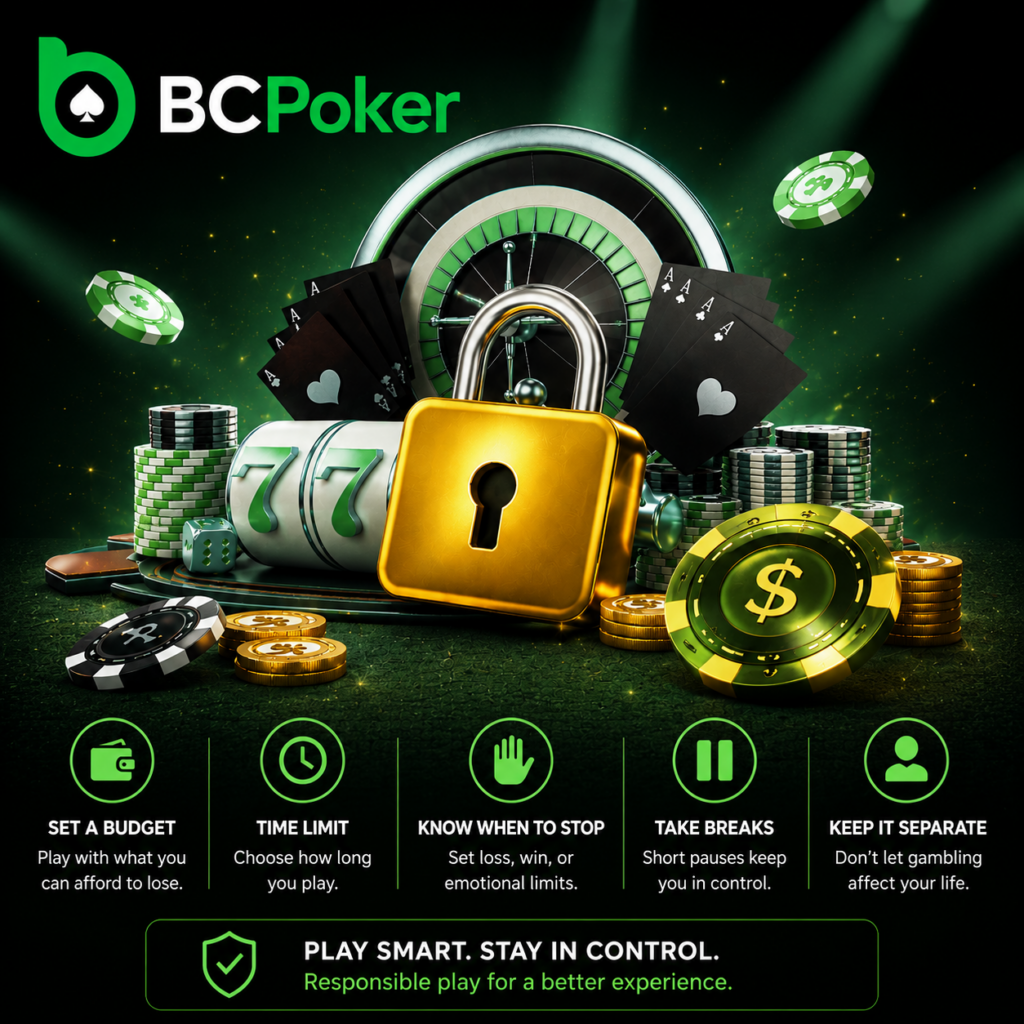
- Session budget – a fixed amount that reflects what you can afford to lose without financial consequence. Once reached, the session ends;
- Time limit – a set duration for the session, independent of whether you are winning or losing;
- Stop conditions – deciding in advance that certain outcomes (a defined loss, a certain win, fatigue, or irritation) end the session automatically;
- Regular breaks – short pauses during longer sessions reduce the risk of decisions made under sustained pressure or tiredness;
- Separate gambling from daily obligations – playing should not come at the cost of work, family time, or other commitments.
Chasing a loss by extending the session or increasing the stake is one of the most common patterns in problem gambling. The correct response to a losing session is to stop, not to continue in order to recover the amount.
BC Poker self check for risk signals in India
The following questions form a personal checklist for evaluating whether gambling habits are developing in a risky direction. Most answers being “yes” is a signal to pause, reduce activity, and consider the break options described in the next section:
- Has gambling started to affect your work performance, attendance, or productivity?
- Have arguments with family members or friends occurred because of gambling activity?
- Do you regularly return to the platform to try to recover money lost in a previous session?
- Have you borrowed money at any point specifically to fund gambling?
- Do you view gambling as a realistic or regular source of income?
- Do you find it difficult to stop playing once a session is underway, even when you intended to stop?
These questions do not constitute a clinical assessment. They are a practical reference point. If the pattern they reveal is consistent, taking a break and seeking independent support is the recommended next step. Gambling Therapy (gamblingtherapy.org) and GamCare (gamcare.org.uk) provide free, confidential assistance.
BC Poker break options and account locking
When personal limits are no longer sufficient, BC Poker provides two account-level tools through Customer Support:
Account-level break tools
| Tool | Details |
|---|---|
| 7-day cooling-off period | A short-term break that removes platform access for 7 days. Suitable for a structured pause without committing to a longer exclusion |
| Self-exclusion (min. 6 months) | A full block on account access for the chosen period. Login access is removed and promotional communications stopped. Cannot be cancelled early |
Both tools are activated by contacting Customer Support. There is no option to reverse self-exclusion before the minimum period ends, including through support.
If you hold accounts on other gambling platforms, BCPoker’s Responsible Gaming guidelines recommend applying self-exclusion on those platforms as well. A partial exclusion that leaves other accounts active reduces the effectiveness of the break.
BC Poker age control and device safety
BC Poker is available only to users aged 18 or older. Each user is responsible for ensuring that their use of the platform complies with the legal gambling age in their jurisdiction, which may be higher than 18 in some regions.
Device and access safety measures for Indian users
- Password-protect the device used to access BC Poker – phone, tablet, or computer;
- Do not leave an active session open on a device that others can access without supervision;
- Keep account details and any linked payment card or wallet information inaccessible to children;
- Do not save the BCPoker login password in a browser or password manager on a shared device;
- Use content-filtering software to restrict access to gambling sites on household devices that minors use.
The user is responsible for access to their own account. If a minor is suspected to have accessed a gambling platform, report it to the platform’s support team for immediate review.
FAQ
What does Responsible Game mean on BC Poker?
It means treating poker and casino games as entertainment with a fixed budget and time limit, not as a source of income or a way to recover financial losses. BC Poker provides guidelines and account-level tools to support this approach.
How do I set personal limits for my sessions?
Decide before each session on a budget you can afford to lose, a time limit, and stop conditions. These are self-imposed – stick to them regardless of session results. Changing limits mid-session because of recent outcomes removes the protection they provide.
What are the warning signs that gambling is becoming a problem?
Key signals include chasing losses, gambling affecting work or relationships, borrowing money for gambling, viewing gambling as income, and difficulty stopping a session. Multiple “yes” answers to the self-check questions on this page indicate elevated risk.
How does self-exclusion work and how long does it last?
Self-exclusion blocks account access for a minimum of 6 months. It is activated through Customer Support and cannot be reversed before the period ends. All promotional communications are stopped for the duration.
What is the difference between a cooling-off period and self-exclusion?
A cooling-off period is a 7-day break that removes access temporarily. Self-exclusion is a minimum 6-month full block that cannot be cancelled early. The cooling-off option is suitable for a short structured pause; self-exclusion is appropriate when a more serious and enforced break is needed.